
Blog
Insight and analysis on Australia’s workforce, recruitment trends, and the forces shaping how we work. Expert perspectives and practical takeaways for job seekers and clients.
Ben Moffatt • August 25, 2025
Powerful Examples of Augmented Reality in Action
*Updated 2025
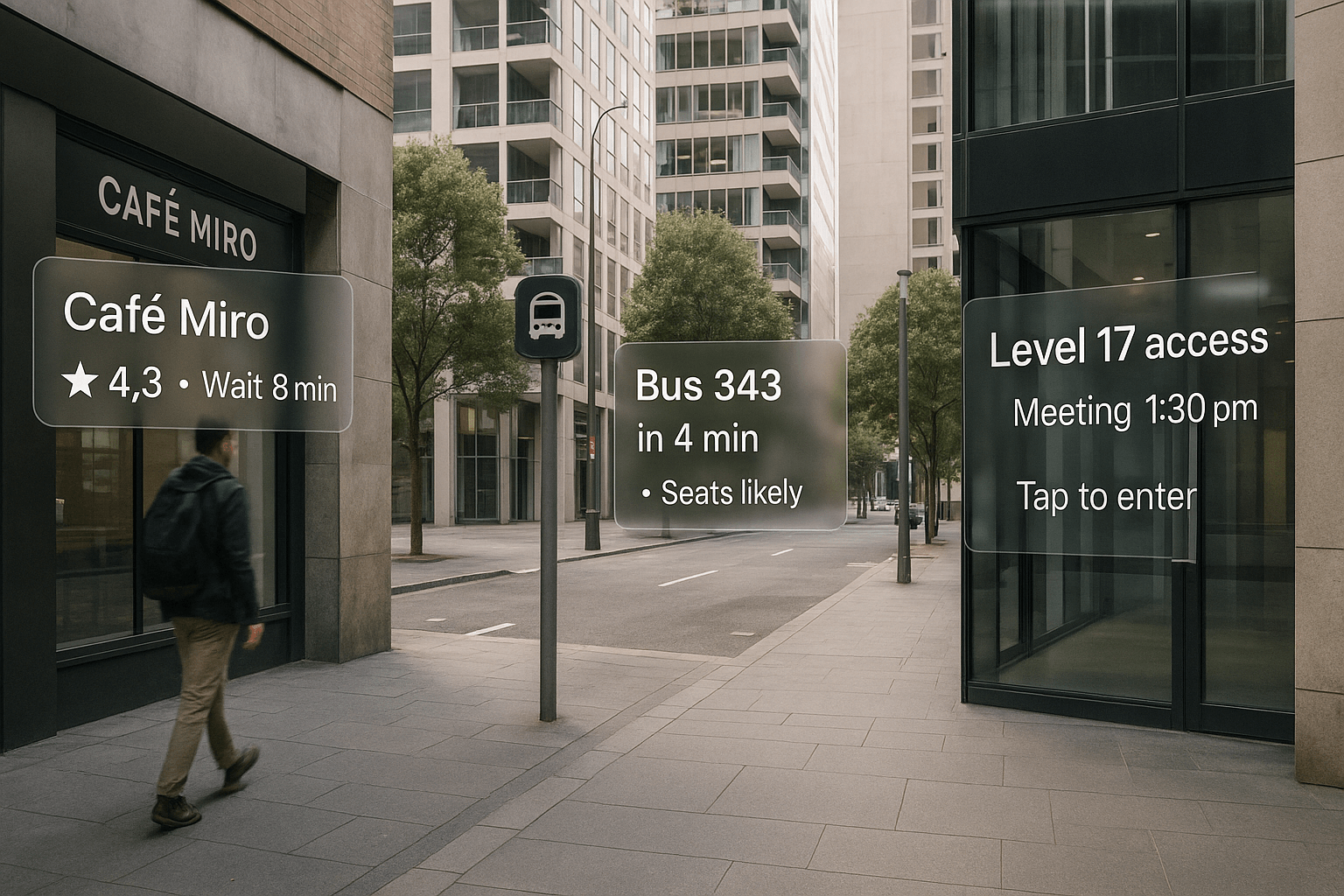
Back in 2020, the headlines were abuzz with news of augmented reality, its exciting applications, and the bold predictions we made about how it would drastically alter the way we live, work, and connect.
To capture the excitement of that time and illustrate the use cases beyond the hype, we put together examples of AR in action.
While still applicable today, the subsequent years of the 2020s have been an era of rapid change, endless announcements about brand new revolutionary tech, and naturally, augmented reality has dropped from the big news cycle. But it’s still very much making waves and influencing how we live, work and connect.
Launch’s Cyber & Infrastructure Recruitment Consultant, Ben Moffatt, sat down with AR and XR expert, Harri, to chart its path.
1990s
Boeing
You may not be aware that augmented reality has actually been around since the 90s, used by the aerospace sector for training. The term augmented reality was actually coined by Boeing researcher Tom Caudell in 1990. Today, Boeing still use AR through Skylight AR Glasses to help engineers access instructions without needing their laptops or papers.
NASA
Throughout that decade, AR was used by the likes of the U.S Air Force Research Laboratory and NASA’s X-38 spacecraft for navigation. This kind of utilisation of AR continues today, as the perfect tool to enhance navigation in both manned and unmanned vehicles. It’s also used to improve workflow for design, maintenance and assembly of these aircraft.
2000s
Nokia
2000 saw the first AR game hit the market, and in 2005, this technology reached our phones when AR Tennis was released – a two-player AR game developed for Nokia phones. Since then, gamers have, unsurprisingly, been the greatest user base for augmented reality, and Pokémon Go was the first to take that trend mainstream.
BMW
BMW was one of the very first brands to use AR for commercial use in 2008 when they utilised the technology to enhance their print advertising with augmented reality. The brand has gone on to use the technology extensively for training, and consumer services like their BMW i Visualizer app, where users can create their own personal BMW i3 or i8, customising the interior and exterior, which then links to a service where users can arrange a test drive.
2010s
Airwalk
In 2010, Airwalk put its faith in marketing firm Y&R when it created an AR campaign to promote the relaunch of some limited-edition shoes, which were in high demand, making them perfect for a teaser campaign such as this. Using geolocation, they made invisible pop-up stores at various locations around the world where users could buy the shoes. The campaign created a huge buzz, attracting massive crowds and significant sales for the limited-edition shoes.
Specsavers
In 2016, Specsavers (and now numerous other glasses retailers across the world) adopted AR to help customers try on glasses via an app or online to help facilitate purchases online. Through their Virtual Try On AR solution, customers simply take a selfie and try on specs to see which suits them best.
AccuVein
In 2016, AR reached the medical world when AccuVein designed a handheld device which is used to scan the vein network of patients, displaying a map of the vasculature directly onto the patients’ skin. This technology led to a 45% reduction in escalations, allowing doctors and nurses to clearly identify what they need to access or avoid.
Cleveland Clinic
Continuing in the medical space, 2016 saw augmented reality being used to teach anatomy to students at the Cleveland Clinic and Case Western Reserve University, using an AR headset. With the technology, students can explore the human body in an interactive 3D format.
NuEyes
Also in 2016, NuEyes was developed – a visual prosthetic that uses specially adapted AR glasses to empower people with visual impairment to see with the help of AR. NuEyes made it possible for many who have not previously been able to see, to now view the world around them while keeping their hands free and without heavy headsets.
Hyundai
Hyundai Australia jumped onto AR in 2017 to help sales staff in dealerships across the country to effectively exhibit the features of the new ‘Reinvented i30’ hatchback. Their in-house AR app gives sales staff the power to really get under the hood and show potential buyers the car’s built-in safety features and a quick, realistic view of how it would look in different colours or with different accessory options.
IKEA
The masters of visual merchandising, IKEA, adopted augmented reality to take their in-store game online. With the IKEA Place app, customers can virtually place IKEA furniture and other products in their home to visualise how it would look, making customers more comfortable to purchase online. In 2017, when the app was launched, more than two million people downloaded it.
Apple and Google
Coca-Cola
Showing how AR can be utilised in the B2B space, Coca-Cola developed an AR solution in 2017 to help retailers visualise what their branded fridges would look like in-store, giving a variety of colour and size options to test out around the store to select the best possible option for their floor plan.
CoverGirl
For on-mobile makeovers, CoverGirl’s 2018 Virtual Makeover became a powerful selling tool that lets their audience try on makeup, using AR and a selfie, before purchasing it online. Through this solution, their entire range can be tested for colour matching and checking combinations.
Gatwick Airport
Gatwick Airport developed its award-winning augmented reality passenger app in 2018 using 2,000 navigation beacons throughout the airport to accurately map travellers’ location and offer valuable information to make their time at the airport as smooth an experience as possible. The services include helping travellers to navigate the airport, as well as personalised, real-time flight updates, gate information and check-in and security queue times.
2020s
Now comprehensively adopted, AR has moved from solely product novelties into everyday workflows across industries.
Cultural preservation and education
Indigital – Launched in 2020, the Indigital Schools program uses AR to bring Indigenous cultural knowledge, history and language to life for students. Through workshops, children learn traditional stories from Elders and then use AR tools to share these stories in their own animated, interactive formats.
Museums and cultural sites – Cultural institutions are increasingly using AR overlays to add depth to exhibitions, allowing visitors to see historical reconstructions, translations, or hidden artefacts via their phones or AR glasses.
Workforce optimisation
DHL Vision Picking – DHL has rolled out AR “Vision Picking” smart glasses in warehouses to guide workers along the most efficient routes to items ready for shipment. The tool reduces unnecessary walking, speeds up order fulfilment, and, as a result, helps to keep energy levels higher across shifts.
Manufacturing and field service – In manufacturing, AR is supporting critical infrastructure mapping, overlaying maintenance instructions directly onto equipment, and enabling remote expert guidance for complex repairs.
Healthcare innovation
Surgical guidance – Surgeons are trialling, on real people, devices like the Apple Vision Pro to overlay 3D anatomical data and patient vitals in the operating room to improve precision and reduce the need to look away from the surgical field of view.
Therapy and rehabilitation – AR is also being used in physical therapy programs to track patient movement, provide visual cues, and gamify exercises to increase engagement.
Consumer and creative experiences
Smart glasses – Devices such as Meta’s Ray-Ban smart glasses, Xiaomi Smart Audio Glasses, and early prototypes like Meta’s Orion show the steady push toward lightweight AR eyewear. While current models focus on media capture, communication and basic overlays, they set the stage for richer AR experiences.
Music learning gamification – New AR-powered platforms deliver “Duolingo-style” interactive lessons for music, overlaying notation and feedback in real time as users play.
Virtual try-on (VTO) – From makeup to eyewear, AR try-on tech is now standard in many e-commerce experiences. Solutions like Perfect Corp enable customers to test looks on their own face via phone camera before buying.
Immersive remote working – Platforms such as Immersed create multi-monitor virtual workspaces inside AR/VR headsets, allowing teams to collaborate in a shared 3D environment from anywhere.
Hardware Insight
For AR headset hardware, there are two parallel tracks: consumer-friendly smart glasses and high-fidelity mixed reality headsets.
Meta’s Ray-Ban glasses are an example of consumer-friendly smart glasses. They are slim and stylish, helping to normalise wearable displays, even if their current capabilities are limited.
In contrast, advanced AR experiences – like those delivered by Apple Vision Pro or Meta Quest 3 – still rely on bulkier headsets. Viewing AR through a headset is called Mixed Reality. It delivers high-fidelity AR, able to process and render complex 3D environments with semantic understanding, just not through the slim and light glasses, which are seen as the desired form.
As the technology matures, these tracks are likely to converge. Meta’s Orion glasses and Snapchat’s Spectacles are the closest to this convergence, with a high level of interactivity and nudging toward the realism that is currently the domain of mixed reality headsets.
The Future of AR
Even though augmented reality has been around for quite some time now, it’s fair to say that it’s still developing in terms of its potential uses. In the professional realm, AR is well and truly established with demonstrative value. For consumers, the current battle for the best hardware will determine just how mainstream our smart glasses will become.
If you’re interested in a career at the forefront of emerging technology, Launch's AI, data and analytics recruitment specialists are here to help.
Share
Have a Question?
Get in touch with us and our friendly staff will get back to you as soon as possible!
Thank you for contacting us.We’ll get back to you as soon as possible.
We got it.