

Victoria’s Tech Sector Shows Stability Amid Selective Hiring

Ed Fletcher • March 3, 2026

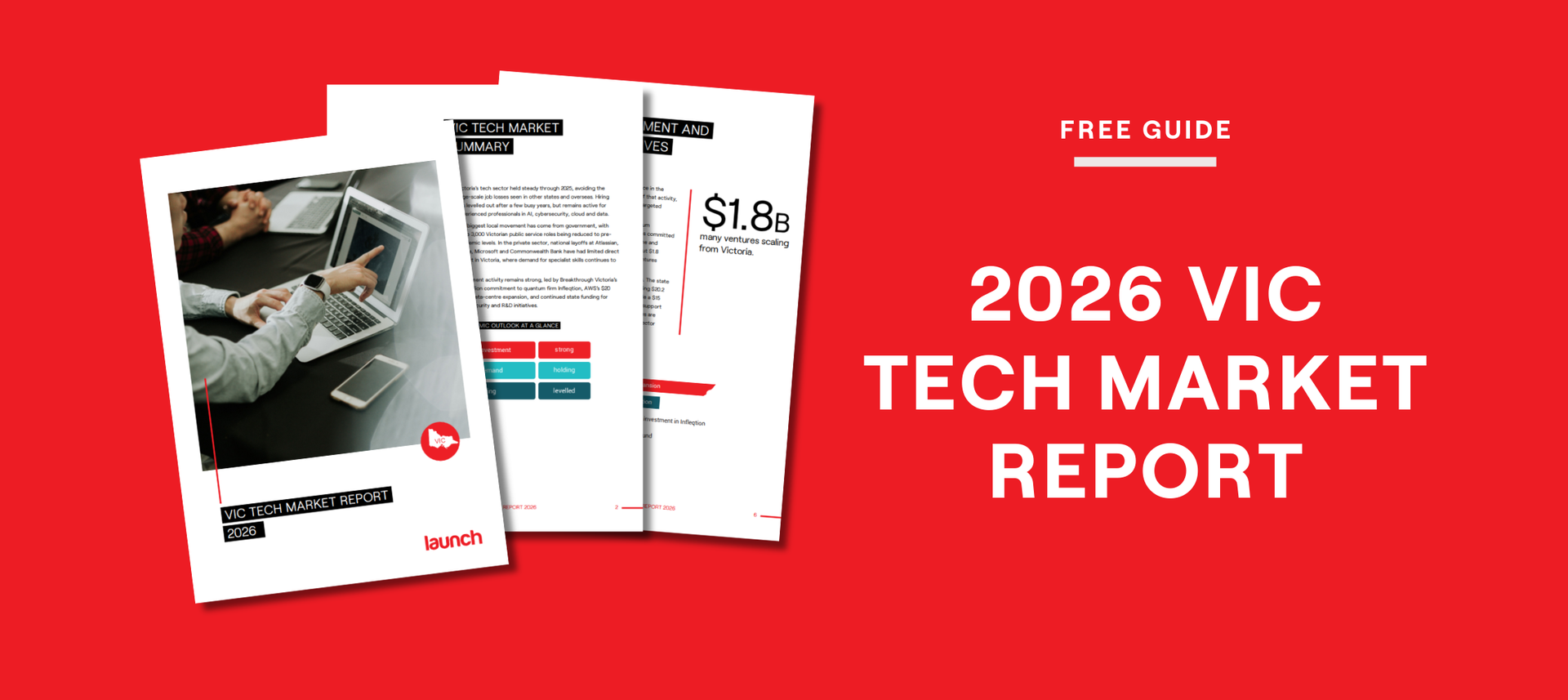
Victoria's tech sector held steady through 2025, avoiding the large-scale job losses seen in other states and overseas, according to Launch Group's latest Victorian Tech Market Update for 2026. 


While activity has eased from the highs of recent years, there is still demand for tech professionals, particularly in specialist disciplines such as AI, cybersecurity, data and cloud. Launch's General Manager – Victoria, Edward Fletcher, says the market has become more measured, with employers taking a more strategic approach to where and how they hire. 

Hiring Trends Reflect a Measured Market 

Victoria recorded an 8.8% fall in overall job vacancies between May and August 2025, according to the ABS. Compared to the 2.7% national average, it's a notable decline. Sydney, by comparison, saw vacancies rise slightly over the same period. Although this data covers all industries, and technology has remained more resilient, it does highlight a more cautious approach to hiring across Victoria. 


"Most of the movement Victoria is seeing now is targeted rather than widespread," Ed says. "It's still an active market, but the intensity of the past few years has come off. Businesses are hiring more deliberately."

Restructures Add Experienced Talent to the Workforce 

Workforce reshaping has occurred nationally through 2025 as technology firms align operations around AI and cost efficiency. Atlassian cut 150 roles, primarily in customer support, while Canva reduced 10 of its 12 technical writing roles as part of an AI integration shift. Microsoft cut 120 roles in Australia, and Commonwealth Bank reduced 164 technology positions nationwide. 


Locally, the most notable workforce adjustments have come from government. Up to 3,000 public service roles are being reduced to pre-pandemic levels, including 350 positions at the Department of Energy, Environment and Climate Action (DEECA). 


Those changes have placed more experienced digital and project professionals back into circulation, creating greater competition for both contract and permanent roles across government suppliers and delivery partners. 


"Projects are still moving forward,” Ed encourages, “but people are thinking harder about how and where they hire. It's just a more careful market than it was two years ago."

Demand Concentrates Around Key Technical Roles 

The strongest demand is for mid-to-senior technical roles, particularly in AI, cybersecurity, cloud and data. While rates and salaries have been reducing across the tech space, these are the areas still commanding above-market remuneration. 

Role/Skill Area Why In Demand? Example Salary Range (25th–75th Percentile) Victoria Notes
AI/ML Engineers & Specialists (e.g., Generative AI Engineer) Rapid AI integration; 60,000 workers needed to transition into AI by 2025. $180,000–$280,000 Melbourne's AI cluster drives 20%+ of national postings; high in fintech/healthcare.
Cybersecurity Specialists/Architects Rising threats; top priority for 50% of hiring managers. $155,000–$220,000 Strong in banking (e.g., post-ANZ restructuring) and government; certifications like CISSP boost demand.
Cloud Architects/Developers (AWS, Azure) Cloud migration boom; integration experts key for 73% of contractors. $152,000–$197,000 (Solutions Architect) Melbourne infrastructure projects (e.g., mining services) fuel 15–20% YoY growth.
Data Scientists/Analysts/Architects Analytics for AI-driven decisions; BI tools like Power BI essential. $155,000–$196,500 (Data Architect) High in manufacturing/transport; Python/SQL skills command 10% premium.
DevOps Engineers (CI/CD, IaC) Automation/scripting for efficiency; scripting (Python/PowerShell) top skill. $140,000–$185,000 Uptick in software engineering (mid-level); hybrid work aids talent access in Melbourne CBD.

But at the lower end of the market, many employers are rethinking how they resource their technical functions. Routine and support work is increasingly being moved offshore — particularly to the Philippines — as businesses look for lower-cost delivery models. Combined with automation, this is tightening local opportunities for entry-level developers and IT support roles. 

Role/Skill Area Why Less Demand? Impact in Victoria
Entry-Level/Junior Developers/Support (e.g., basic coding, IT helpdesk) AI automating routine tasks; hiring rate for P1/P2 roles at 8% (down from 35%). Melbourne grads face 4x application competition; 60k entry roles at risk nationally.
Basic IT Operations/Networking Cost-cutting in non-core functions; offshoring concerns. Banking layoffs (e.g., ANZ's 3,500 cuts, many tech ops in Docklands) hit hardest; public sector efficiencies add pressure.
Non-Specialised Marketing/People Roles in Tech Attrition stable at 19%, but hiring down 72–75% for support functions. Limited in pure tech, but affects startups; Melbourne media/tech crossover saw Q3 hiring drop.

"It's not just a slowdown at the junior end," Ed says. "We're seeing some of those functions disappear altogether as teams offshore, consolidate, automate, and look to AI-driven solutions." 

Investment Strengthens Victoria’s Digital Economy 

Despite tighter budgets and workforce reshaping, investor confidence in Victoria's digital economy is strong. Investments are flowing into both large-scale private projects and targeted government programs aimed at strengthening the state's technology base. 


Breakthrough Victoria invested $29 million in quantum computing firm Infleqtion in 2025, helping to cement Melbourne's reputation as a hub for emerging technologies. Amazon Web Services also announced a $20 billion expansion of its Australian data-centre infrastructure, with Melbourne identified as a key region alongside Sydney. 


Melbourne now hosts Australia's largest AI cluster, with around 188 companies, according to Information and Data Management News. That concentration of expertise is reinforcing the city's position as a centre for innovation and advanced technology development. 


On the public side, the Victorian Government allocated $100 million to cybersecurity initiatives, including $20.2 million for digital upgrades in the health sector. It also launched a $15 million Industry R&D Infrastructure Fund to support business innovation. Existing initiatives, such as those through LaunchVic and Innovate Victoria, continue to support local startups and accelerate technology adoption across various industries. 


Ed believes this level of investment highlights continued confidence in the state's technology capability. "The money coming into Victoria — whether it's cloud infrastructure, quantum computing or cybersecurity — shows that businesses and government see tech as critical to the state's growth," he says.

Hiring Behaviour Highlights a Drop in Candidate Care

While candidates at the technical senior end of the market are highly sought after, many in project services, particularly those in less technical or junior roles, are experiencing high competition in a 'buyer's market', where organisations have the pick of the bunch. 


Many of those candidates say they feel they are being left in limbo. "It's become pretty common to hear from candidates that they've had no feedback at all," he says. "Some are waiting weeks after final interviews and still don't get a response. Others are having rates pushed down well below what's fair." 


Ed says the tone of the market has shifted as businesses lean harder on commercial pressure. "There's a difference between being commercial and being fair,” he cautions. 

Outlook for 2026: Stability, Capability and Careful Hiring 

Victoria's tech market remains tentatively stable but cautious. Overall, job vacancies have reduced, with an 8.8% decline in mid-2025 compared to 2.7% nationally, yet demand for experienced professionals in AI, cybersecurity, cloud and data is still strong. These roles are proving the hardest to fill, making them the most sought after by employers across both the public and private sectors. 


More broadly, tech hiring is cautious rather than contracting. Targeted restructures in both the public and private sectors have added competition but not derailed hiring momentum, and strong investment—from Breakthrough Victoria's $29 million quantum funding to AWS's $20 billion cloud expansion—continues to underpin confidence in the state's digital economy. 


Looking ahead to 2026, Victoria's tech market is expected to hold steady, with focus shifting to capability, efficiency and delivery. Employers are hiring more selectively and looking for deeper technical expertise, while high-demand candidates are becoming more selective about opportunities, and mid-demand candidates are prioritising transparency and respect in the process. For both sides, fairness and clear communication are likely to deliver stronger long-term outcomes than short-term savings or rushed decisions. 


Download our free guide below.

Share this article

Recent Posts

Person using a laptop, hands on keyboard, viewing a data dashboard with charts and graphs.
By Hayden Lines March 2, 2026
NSW drives Australia’s 2025 job growth as tech hiring splits in two: rising competition for senior roles, strong demand for cloud, cyber, data and AI talent.
People planting seedlings in a field with mountains in the background under a cloudy sky.
By Steph Obrien February 2, 2026
Launch has partnered with 15TREES to plant 60 native trees in the Daintree Rainforest, bringing its total contribution to 180 trees across Australia.
Woman and man holding an award with logos in background. Woman in black blazer, man in tuxedo.
By Amanda Saleh January 20, 2026
Sarah Kiely is announced as Launch Group CEO, succeeding outgoing CEO Damien Ross, taking Launch Group into an exciting new chapter for the company.
Man in a blue shirt looks out of a high-rise window, city skyline in background.
By Jaz Kuthubdeen January 12, 2026
Counteroffers may buy time, but they rarely fix the reasons people leave. Launch’s Jaz Kuthubdeen explains why they often fail both candidates and employers.
Four people walking and talking in an office hallway.
By Ariana Harris December 8, 2025
Contracting roles are growing in corporate services. Learn how shifting expectations around tenure, cost and capability help employers hire smarter with Launch.
Tiara Recruitment Awards ANZ winner logo.  Launch logo and text
By Steph Obrien December 8, 2025
Launch wins Back Office of the Year at the 2025 TIARA Awards, celebrating excellence in recruitment operations and team performance across ANZ. Read more here.
Cyber security trends - Detection, Identity, AI Security
By Steph Obrien October 20, 2025
Discover FY26 cyber security hiring trends in Australia. Detection, IAM/PAM, and AI security drive demand amid regulation, skills gaps, and rising salaries.
Burnout management image yoga mat, candle, water and headphones
By stephanieobrien October 14, 2025
Burnout will sadly affect the majority of Australians. With it so pervasive, to manage and recover from burnout starts with understanding it.
Man with glasses intently looking at computer screen with lines of code in a dim room.
By Imogen Hough October 6, 2025
AI is reshaping software engineering roles in Australia. Learn which skills matter most, from system design to AI literacy, to stand out to employers.
Office scene: Person in suit walking away from a desk with chair, notebook, and water glass.
By Liz Frank September 29, 2025
Learn how to reduce time to hire with faster approvals, pre-booked panels and clear SLAs. Secure the best candidates before they're gone.
Show More